
This tool was designed under a US Navy contract for designing a complex SDR application. The SMT9650 is a host side software package that allows Labview to be used with a parallel application executing on multi-DSP and multi-FPGA hardware. Labview has a rich set of virtual instruments that can be used by the DSP/FPGA application. The package was primarily designed to work with code generated by PARS from Simulink models but it can also be used with parallel applications developed with Diamond DSP/FPGA package. To get the best development experience we recommend using PARS as the base development system.
An application built with the SMT9650 comprises two parts: a Labview front-end running on a PC and a DSP application running on the attached or embedded DSP+FPGA hardware
The Labview front-end uses custom Virtual Instruments (VIs) to load the DSP application and communicate with it.The nature of the communication between the PC and the attached hardware is invisible to the user; the various combinations permitted by Sundance hardware (host comport or USB connection, for example)are managed by the underlying systems software.
Applications
DSP and/or FPGA applications generated using PARS can be combined with a front-end developed under Labview.
Labview Interface
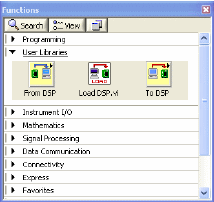 The Labview interface is presented as seven virtual instruments:one to load the Sundance hardware, three to get data from the DSP application, and three to send data to the DSP application. These instruments appear as User Libraries in the Labview Functions palette. You can display this palette by going to the Block Diagram window and selecting View/Functions Palette .
The get_… instruments receive data from the DSP application in the form of arrays of values of the selected type;the size of array is determined by the DSP.For example,get_int.vi returns an array of 32-bit integers.
The put_… instruments send arrays of the selected type to the DSP application.For example, put_float.vi sends arrays of 32-bit floating point values.The size of array transmitted must match the expectation of the receiving DSP code.