
Introduction
Embedded systems are rapidly evolving beyond traditional centralized computing models. Today’s industrial, defense, communications, and AI applications increasingly require intelligent processing at the edge, where data is generated. These systems must deliver high performance while maintaining low power consumption, strong security, deterministic operation, and long-term deployment flexibility.
The PolarBerry platform addresses these requirements by combining Microchip’s PolarFire® SoC FPGA technology with a familiar Raspberry Pi-compatible development environment. By integrating a multicore RISC-V processor subsystem, FPGA acceleration, extensive I/O connectivity, and optional Power over Ethernet (PoE), PolarBerry enables engineers to develop secure, remotely deployable edge computing solutions on a compact, highly flexible platform.
One of the key advantages of PolarBerry is its standard 40-pin Raspberry Pi-compatible expansion connector, allowing developers to use a vast ecosystem of sensors, communication modules, displays, industrial interfaces, and custom FPGA-based hardware accelerators.
This article explores how the PolarBerry platform can be used to build secure edge computing systems, explains the importance of RISC-V technology, examines the security advantages of the PolarFire SoC architecture, and demonstrates how the Raspberry Pi-compatible connector enables rapid system integration.
Introducing PolarBerry
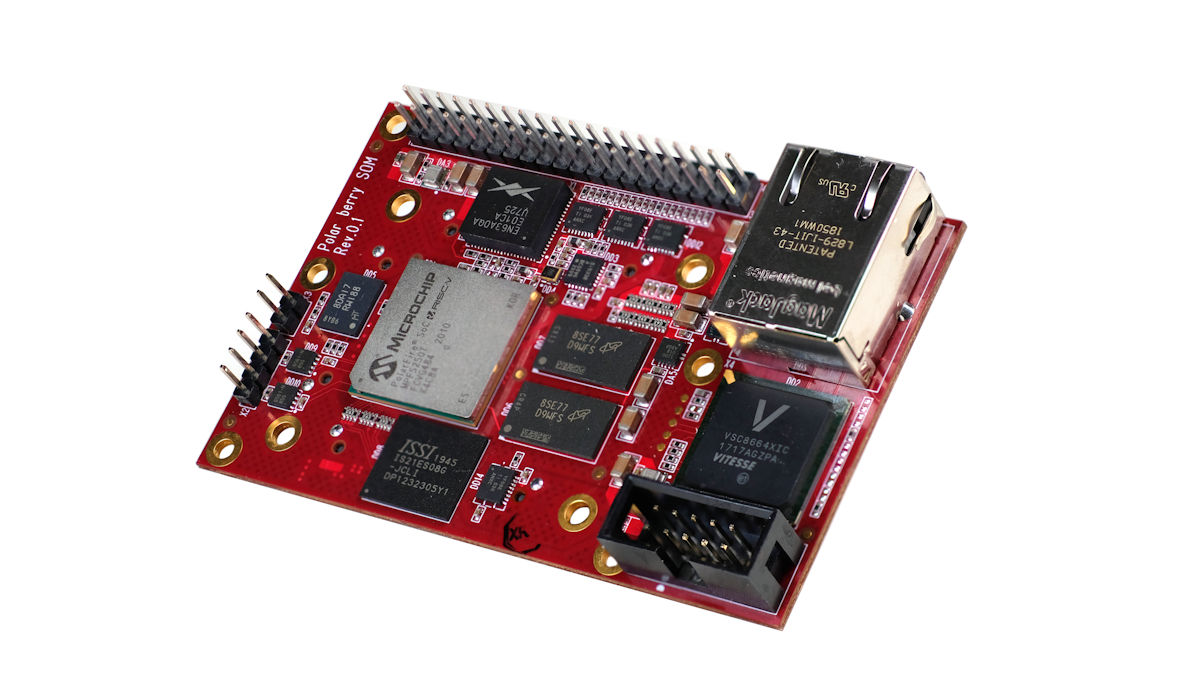
PolarBerry is a compact FPGA System-on-Module based on the Microchip PolarFire SoC FPGA MPFS250T-FCVG484 device. Measuring just 55 mm × 85 mm, the module combines FPGA fabric, multicore RISC-V processing, high-speed memory, networking interfaces, and expansion connectivity into a production-ready embedded platform.
Typical PolarBerry configurations include:
- PolarFire SoC FPGA (MPFS250T)
- 4 GB DDR4 memory
- 4 GB eMMC Flash storage
- 128 MB SPI Flash
- Gigabit Ethernet
- CAN interfaces
- High-speed serial transceivers
- Raspberry Pi-compatible 40-pin connector
- FPGA expansion interfaces
The module is designed for applications that require a combination of software flexibility and hardware acceleration, including:
- Defense and aerospace systems
- Industrial automation
- Smart cameras
- Robotics
- Machine vision
- Edge AI inference
- Communications infrastructure
- Secure IoT deployments
- Scientific instrumentation
Unlike traditional single-board computers, PolarBerry provides direct access to FPGA resources, enabling developers to accelerate computationally intensive workloads while maintaining software programmability through the integrated RISC-V processors.
Why RISC-V Matters
One of the most significant aspects of PolarBerry is its use of RISC-V processors.
RISC-V is an open Instruction Set Architecture (ISA) that is rapidly transforming the embedded computing landscape. Unlike proprietary processor architectures, RISC-V provides an open standard that can be implemented and extended by any organization without licensing restrictions.
For system designers, this offers several important advantages.
Freedom from Vendor Lock-In
A single architecture owner often controls traditional processor ecosystems. RISC-V allows developers to build systems using an open standard supported by multiple semiconductor vendors, reducing long-term supply chain risk and improving design flexibility.
Customization and Innovation
Because RISC-V is open, designers can create processor extensions tailored to specific applications. This capability is particularly attractive for artificial intelligence, signal processing, cryptography, and defense applications where specialized instruction sets can provide significant performance advantages.
Rapidly Growing Ecosystem
The RISC-V ecosystem has matured rapidly in recent years. Developers can now choose from a wide range of software tools and operating systems, including:
- Linux
- Yocto
- FreeRTOS
- Zephyr
- Bare-metal development frameworks
This growing ecosystem provides developers with a stable foundation for future designs.
Security Through Transparency
Open architectures allow researchers and developers to analyze implementations more thoroughly than proprietary alternatives. This transparency can improve trust and enable deeper security verification, particularly in critical infrastructure and defense applications.
As governments and major technology companies continue investing in RISC-V technology, adoption is expected to accelerate across embedded and edge computing markets.
The PolarFire SoC RISC-V Architecture
At the heart of PolarBerry is the PolarFire SoC processor subsystem, which integrates five hardened RISC-V cores alongside FPGA fabric.
The architecture includes:
- Four RV64GC U54 application cores
- One RV64IMAC E51 monitor core
- Shared L2 memory subsystem
- Hardware cache coherency
- Linux and real-time operating system support
This heterogeneous architecture enables developers to run Linux applications on the U54 cores while assigning real-time tasks to dedicated cores or FPGA accelerators.
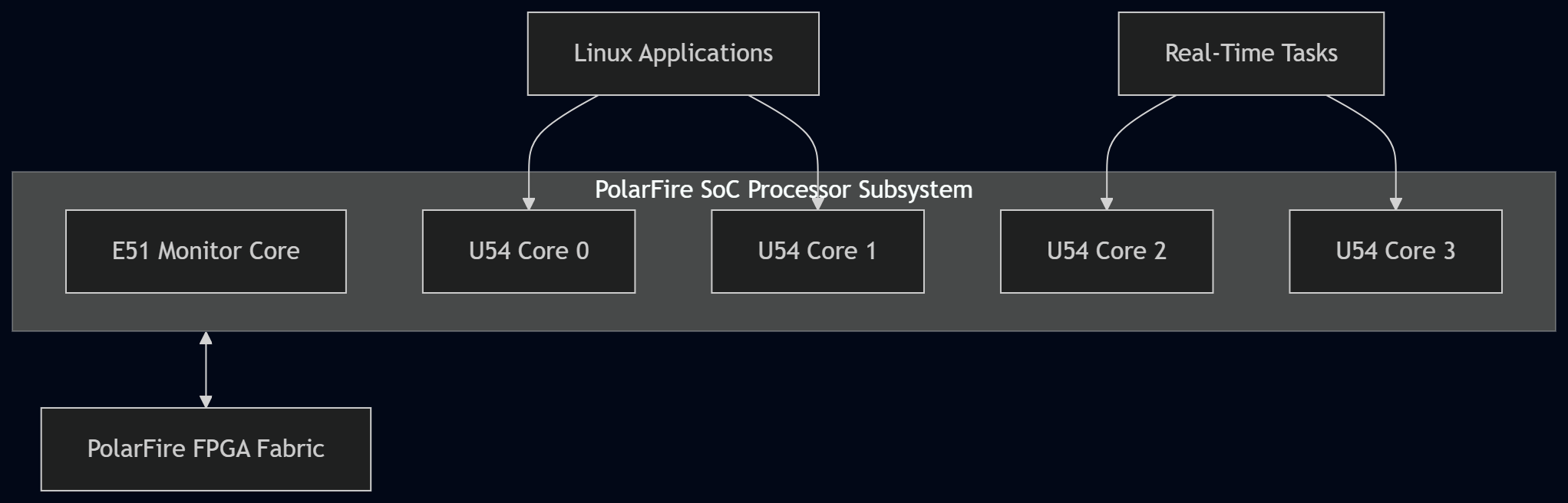
This combination of Linux processing, deterministic real-time execution, and FPGA acceleration is one of the key differentiators of PolarFire SoC technology compared to conventional processor-based embedded platforms.
Power Efficiency: A Key PolarFire Advantage
Power consumption has become a critical design consideration for modern embedded systems. Higher power consumption increases thermal management requirements, reduces reliability, and raises operating costs.
The PolarFire SoC family was specifically designed to deliver high performance while maintaining exceptionally low power consumption.
Depending on FPGA utilization, a PolarBerry system typically consumes significantly less power than many competing FPGA-based platforms. The complete module has a maximum power consumption of approximately 16 W, while the FPGA itself typically consumes around 12 W under demanding workloads.
These characteristics provide several practical benefits:
- Reduced cooling requirements
- Improved system reliability
- Fanless operation in many applications
- Lower operating costs
- Smaller enclosure designs
- Longer deployment lifetimes
For edge computing applications deployed in remote locations, lower power consumption directly translates into simpler and more reliable system designs.
Security by Design
Security is no longer optional for connected embedded systems. Whether protecting intellectual property, securing communications, or preventing device cloning, modern systems require robust hardware-rooted security.
The PolarFire SoC architecture incorporates multiple layers of security, including:
- Secure boot
- Hardware root of trust
- Device authentication
- Bitstream encryption
- Anti-cloning protection
- Secure key storage
- Physical memory protection
- Secure firmware update mechanisms
These capabilities help ensure that only authorized firmware and FPGA images can execute on the device while protecting sensitive intellectual property throughout the product lifecycle.
For defense, industrial, and critical infrastructure applications, these features provide a strong foundation for building trusted systems.
How PolarFire Security Compares
Several modern FPGA families provide security features such as encrypted bitstreams and secure boot. However, PolarFire combines strong security capabilities with low-power operation and an open RISC-V processing architecture.
| Capability | PolarFire SoC | Competing FPGA Families |
|---|---|---|
| Secure Boot | Yes | Yes |
| Bitstream Encryption | Yes | Yes |
| Device Authentication | Yes | Varies |
| Hardware Root of Trust | Yes | Available on many devices |
| Anti-Cloning Protection | Strong | Varies |
| Integrated RISC-V Processing | Yes | Typically ARM-based |
| Low-Power Operation | Excellent | Generally higher |
While competing FPGA families may offer similar security mechanisms, PolarFire distinguishes itself through the combination of security, power efficiency, and deterministic multicore RISC-V processing.
This combination is particularly attractive for defense, aerospace, and edge computing deployments.
Optional Power over Ethernet for Remote Deployments
One of the most interesting capabilities available on recent PolarBerry revisions is optional Power over Ethernet (PoE) support.
With PoE-enabled PolarBerry variants, both power and network connectivity can be delivered through a single Ethernet cable.
This simplifies deployment by eliminating the need for separate power supplies and dedicated power wiring.
Applications include:
- Smart cameras
- Industrial monitoring systems
- Remote sensing platforms
- Building automation
- Edge AI devices
- Secure communications equipment

In a typical deployment, a PoE-enabled switch or injector provides both network connectivity and power to the remote system.
Because a fully configured PolarBerry platform may consume up to approximately 16 W, designers should ensure that their PoE infrastructure provides sufficient power budget. In many applications, PoE+ equipment offers additional operating margin.
This capability enables deployment distances of up to approximately 100 metres using standard Ethernet cabling, making PolarBerry an excellent platform for distributed edge computing systems.
Building Fully Remote Intelligent Systems
The combination of PoE, Linux, FPGA acceleration, and Gigabit Ethernet makes PolarBerry particularly attractive for remote deployments.
A typical architecture might consist of multiple intelligent edge nodes connected to a central control system.
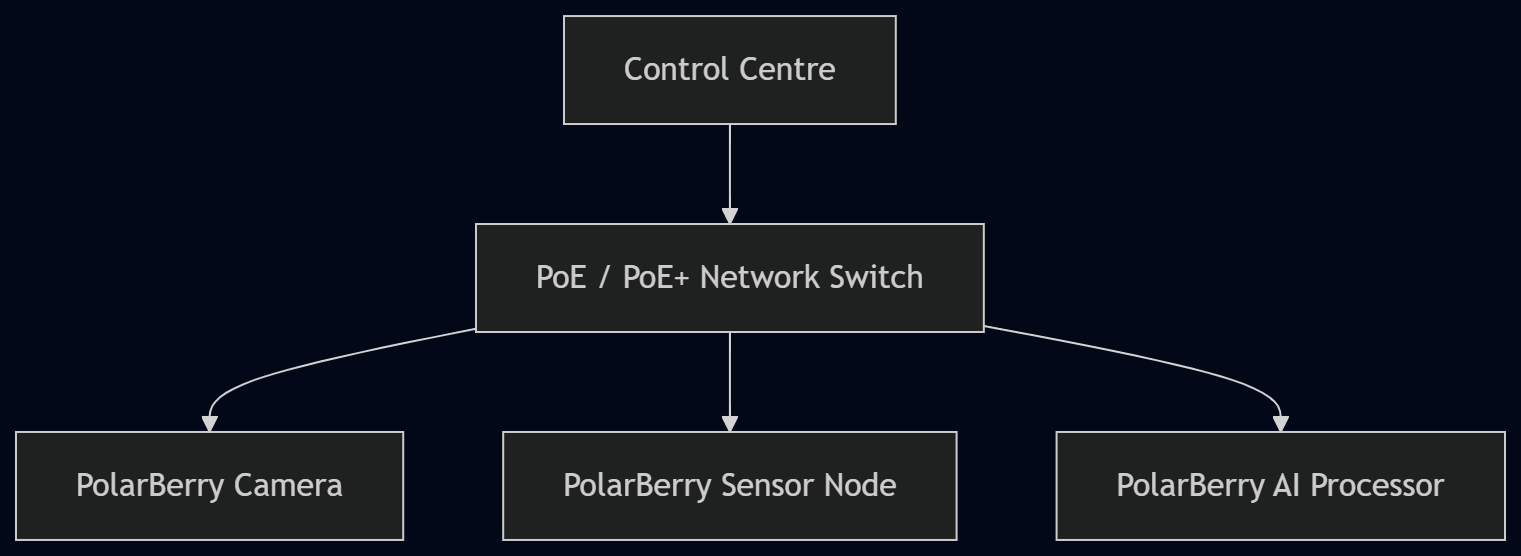
Each node can:
- Receive power through Ethernet
- Process sensor data locally
- Execute AI algorithms
- Accelerate workloads using FPGA logic
- Communicate securely with central systems
- Receive remote software updates
This architecture significantly reduces installation complexity while improving system scalability.
Understanding the PolarBerry RPI Connector
One of the most developer-friendly features of PolarBerry is its standard Raspberry Pi-compatible 40-pin expansion connector.
The connector provides approximately 26 GPIO signals, including:
- 20 FPGA-connected GPIOs
- 6 processor-connected GPIOs
- 1 I²C interface
- 1 UART interface
All signals operate at 3.3 V logic levels.
Unlike conventional Raspberry Pi systems, many of these signals can be connected directly to custom FPGA logic, enabling deterministic hardware-level processing and interface customization.
What Can You Connect to the RPI Header?
The Raspberry Pi ecosystem offers a vast range of expansion boards and peripherals that can be connected directly to PolarBerry.
Examples include:
Sensors
- Temperature sensors
- Pressure sensors
- Environmental monitoring devices
- Inertial Measurement Units (IMUs)
- GPS receivers
Industrial Interfaces
- Relay boards
- Industrial I/O modules
- Motor controllers
- PLC interface hardware
Robotics
- Servo controllers
- Motor drivers
- Encoder interfaces
- Navigation sensors
Communications
- UART peripherals
- SPI devices
- Custom communication interfaces
- FPGA-implemented protocols
AI and Vision Systems
- Camera modules
- Custom sensor boards
- FPGA accelerators
- Edge AI peripherals
This flexibility allows PolarBerry to serve as a bridge between the software-oriented Raspberry Pi ecosystem and the hardware acceleration capabilities of modern FPGA technology.
Direct FPGA Access Through the Expansion Connector
Perhaps the most powerful aspect of the Raspberry Pi connector is direct access to FPGA resources.
Many single-board computers provide fixed-function GPIO interfaces with limited timing determinism. PolarBerry allows developers to connect external devices directly to custom FPGA logic.
This enables:
- Deterministic control systems
- Hardware protocol implementation
- High-speed signal processing
- Precision timing applications
- Custom communications interfaces
- Real-time data acquisition
For engineers developing advanced embedded systems, this capability opens opportunities that are simply not available on processor-only platforms.
Development Environment
PolarBerry benefits from the broader PolarFire SoC development ecosystem, providing developers with a mature set of software and hardware design tools.
Supported technologies include:
- Microchip Libero® SoC Design Suite
- Mi-V RISC-V ecosystem
- Linux
- Yocto Project
- FreeRTOS
- Zephyr
- FPGA hardware acceleration frameworks
This allows developers to combine familiar software development workflows with custom FPGA acceleration in a single integrated platform.
Design Considerations
While PolarBerry offers exceptional flexibility, developers should consider several practical factors when designing systems.
- PoE support is available on selected board revisions and ordering options.
- Expansion peripherals connected to the RPI header must support 3.3 V logic levels.
- FPGA acceleration requires development using Libero SoC design tools.
- High-performance FPGA workloads should be considered when planning power budgets.
- System architecture should account for thermal and environmental requirements in remote deployments.
Addressing these considerations early in the design process can help ensure successful product deployment.
Conclusion
PolarBerry combines many of the technologies that are shaping the future of embedded computing into a single compact platform.
Built around the PolarFire SoC FPGA, it delivers:
- Multicore 64-bit RISC-V processing
- FPGA hardware acceleration
- Hardware-rooted security
- Low power consumption
- Linux and RTOS support
- Deterministic real-time operation
- Raspberry Pi-compatible expansion
- Optional Power over Ethernet capability
The standard 40-pin Raspberry Pi connector allows developers to use a vast ecosystem of sensors, interfaces, and expansion modules while maintaining direct access to FPGA resources for hardware acceleration and custom logic development.
Combined with the low-power, secure, and flexible architecture of PolarFire SoC technology, PolarBerry provides an ideal platform for next-generation edge computing systems, industrial automation, intelligent sensing, robotics, communications infrastructure, and defense applications.
As RISC-V adoption continues to accelerate across the industry, platforms such as PolarBerry offer developers a practical path toward building secure, efficient, and highly customizable embedded systems for the future.