
SE2000 + FMC-ADC500CD
The four-part “Versal Gen 2 and SDR” series is now complete. It covered architectural evolution, decoupling vector math operations, solving data starvation challenges, and the critical path from model to mission in Software Defined Radio (SDR) applications.
This supplementary article directly responds to the many defense and aerospace organizations that have reached out asking how the Sundance DSP SE2000 3U SOSA-aligned OpenVPX PIC combined with the FMC-ADC500CD FMC module can help them design state-of-the-art SDR systems. The pairing provides high-bandwidth multi-channel data capture capability together with low, bounded, and predictable latency processing on the AMD Versal Gen 2 adaptive SoC, essential for modern electronic warfare (EW), signals intelligence (SIGINT), radar, and multi-function SDR platforms.
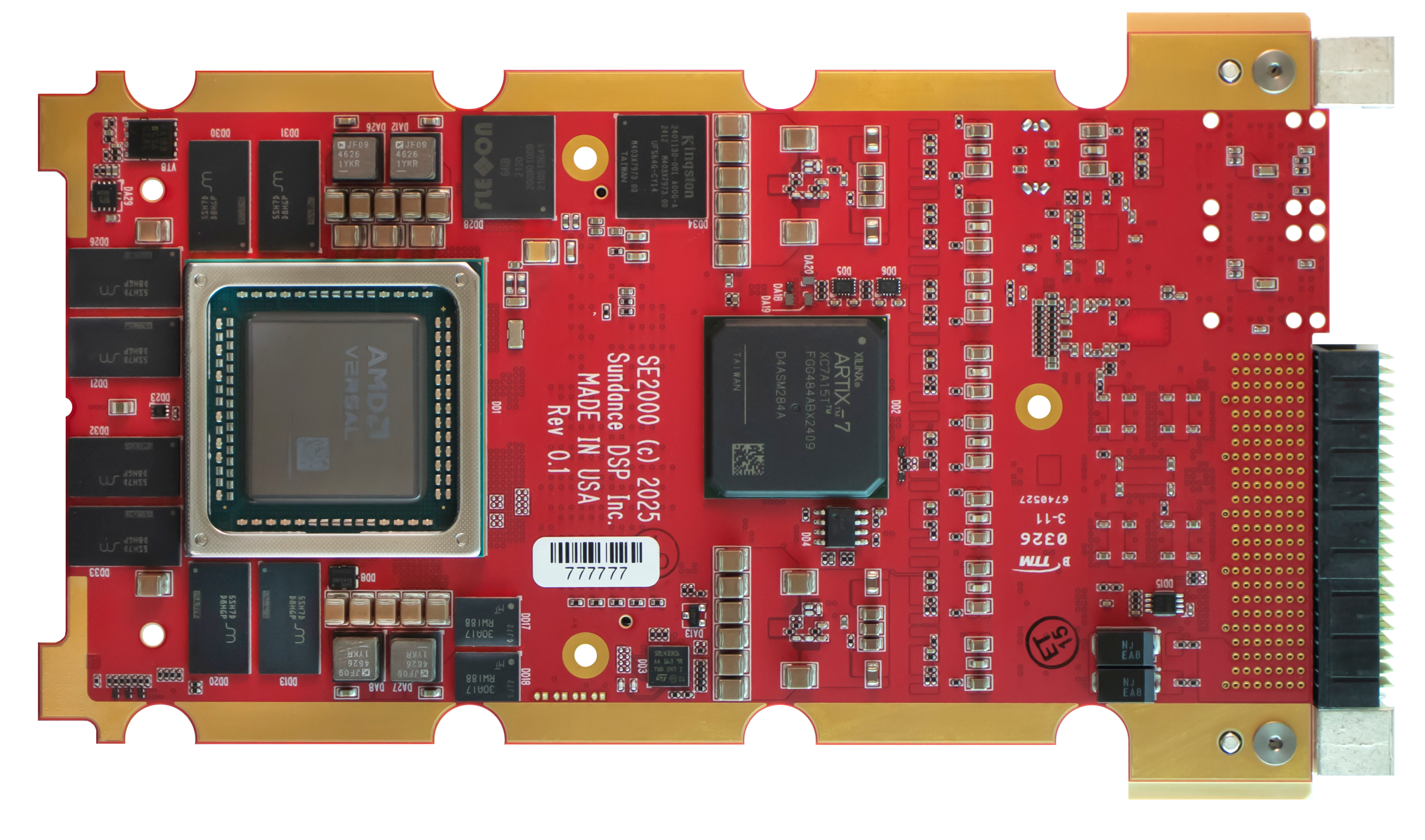
The SE2000: A Rugged Versal Gen 2 VPX Platform
The SE2000 is a 3U SOSA-aligned OpenVPX Payload Integration Card built around AMD Versal AI Edge Gen 2 and Prime Gen 2 devices, with device options providing up to 20 GTYP transceivers. It features robust support for security (TA101 + TPM 2.0), extensive memory (16 GB eMMC expandable, QSPI, UFS), high-quality clocking via Si5341, and an FMC+ site supported by an Artix FPGA for management functions, interface control, and coordination of configurable I/O resources.
Designed for both conduction (VITA 48.2) and air (VITA 48.8) cooling, supporting configurations approaching 200 W subject to chassis and cooling capabilities, the SE2000 is optimized for SWaP-constrained deployed environments in defense and aerospace while maintaining full SOSA interoperability for modular open systems architectures (MOSA).
The FMC-ADC500CD: High-Performance JESD204B Data Conversion
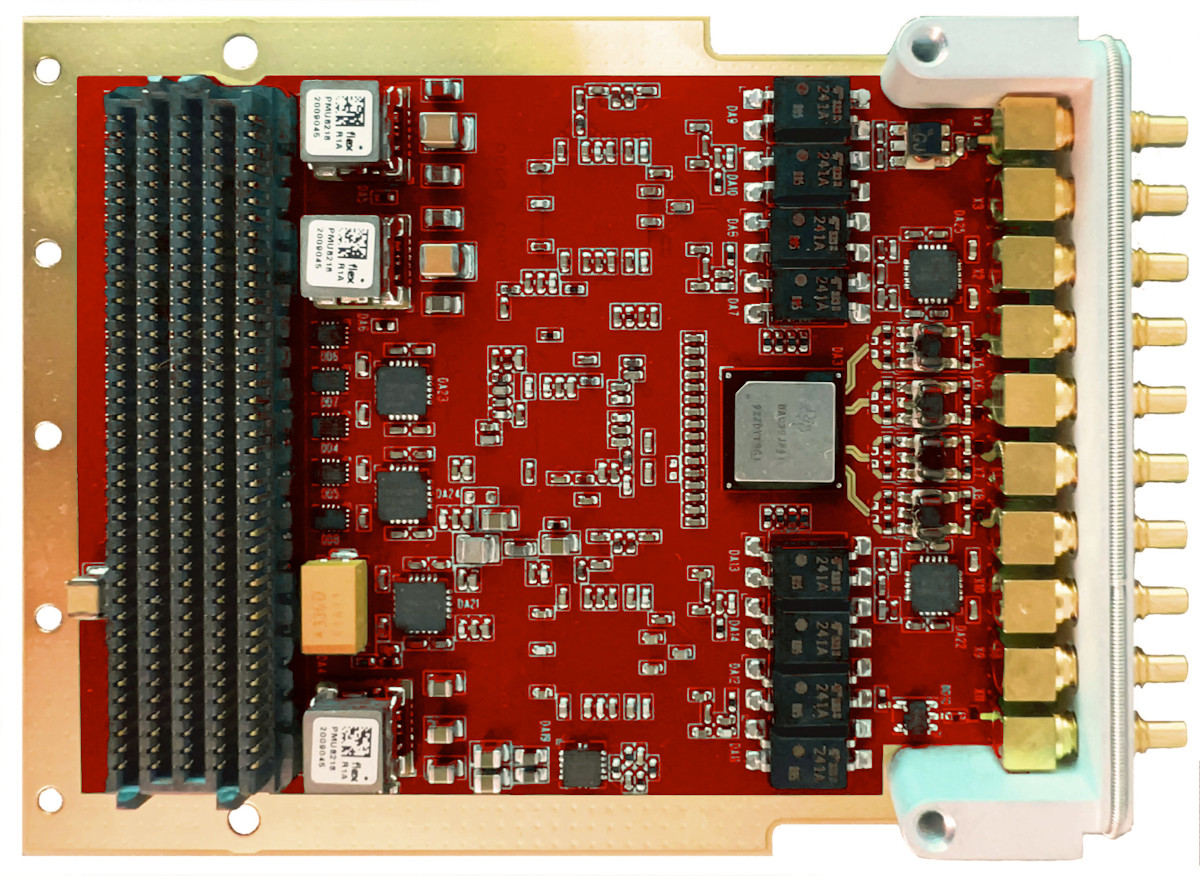
The FMC-ADC500CD is a high-performance HPC FMC+ module that delivers
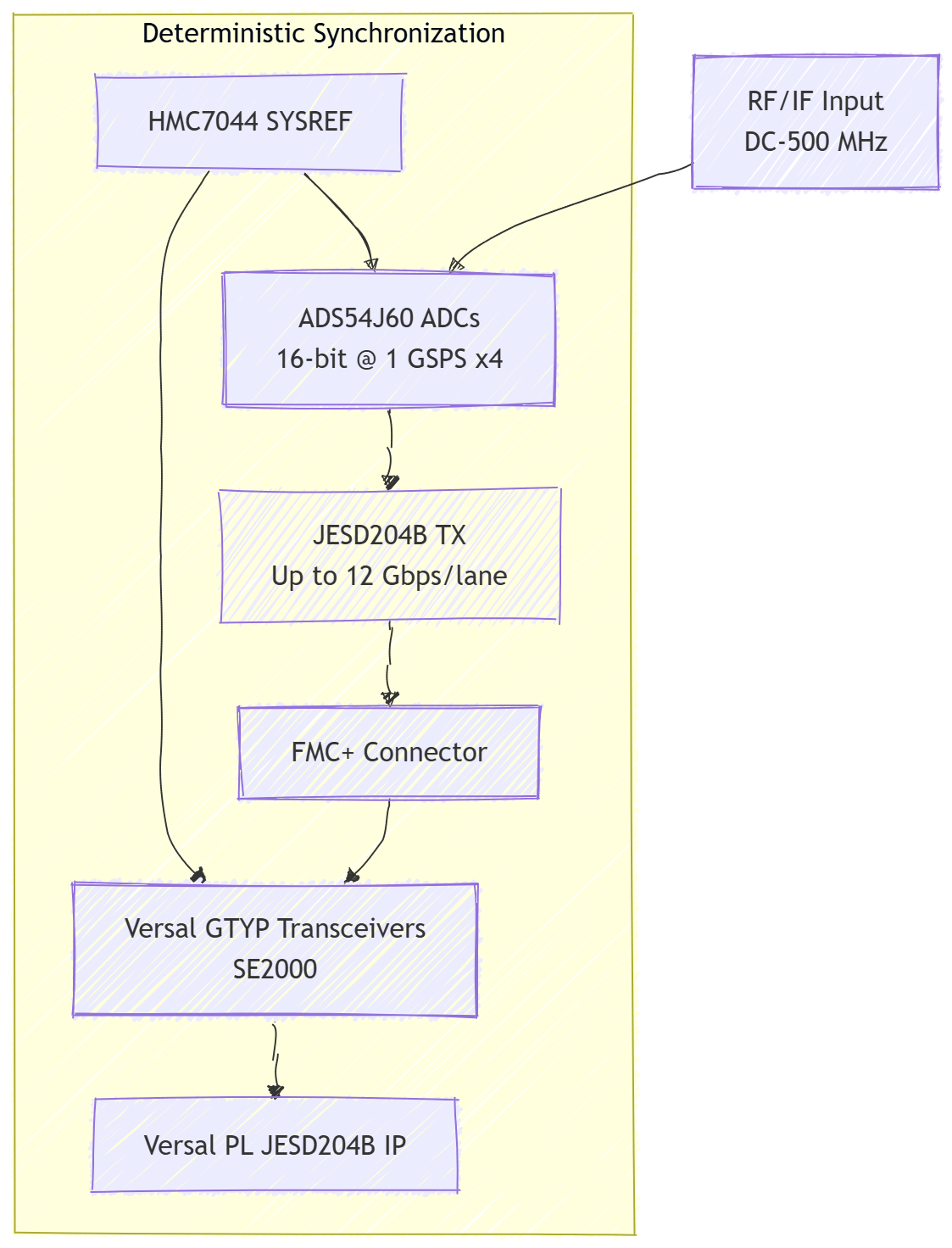
- Four 16-bit, 1 GSPS ADCs (dual ADS54J60) capable of digitizing signals across multiple Nyquist zones, providing up to approximately 500 MHz of instantaneous bandwidth per channel in first-Nyquist operation (AC/DC coupling selectable).
- Quad 16-bit DAC (DAC39J84) supporting sample rates up to 2.8 GSPS and RF signal synthesis extending beyond 1 GHz, depending on Nyquist-zone operation and reconstruction filtering.
- JESD204B interfaces operate at up to 12 Gbps per lane, with lane usage depending on converter configuration.
- HMC7044 clock distributor enabling precise SYSREF generation and Subclass 1 deterministic synchronization.
- External trigger, clock input, and stable onboard VCXO/TCXO references.
When mated to the SE2000’s FMC+ site, the JESD204B lanes are routed to dedicated GTYP transceivers on the Versal Gen 2 through the SE2000 FMC+ interconnect architecture, creating a tightly integrated high-bandwidth pipeline.
Why This Combination Is Ideal for Next-Gen Defense and Aerospace SDR
Modern SDR systems must simultaneously handle:
- High ingest bandwidth for spectrum sensing or multi-channel radar.
- Low, bounded, and predictable latency for closed-loop responses in contested electromagnetic environments.
- Ruggedness, modularity, and security for platform integration.
- Efficient blending of high-speed DSP, vector processing, and control logic.
The SE2000 + FMC-ADC500CD combination meets these requirements effectively. It allows organizations to capture and process high-bandwidth, multi-channel RF data streams with highly deterministic and predictable timing characteristics on the Versal Gen 2’s heterogeneous combination of programmable logic, AI Engines, NoC infrastructure, and processing subsystems.
JESD204B Interface: High-Bandwidth, Deterministic Capture and Generation
JESD204B provides a serial, multi-lane protocol that delivers high throughput with excellent synchronization capabilities. On the FMC-ADC500CD, it supports Subclass 1 operation via the HMC7044 for deterministic converter interface latency.
JESD204B Data Capture Flow
A similarly deterministic path can be implemented for DAC signal generation, enabling coherent transmit/receive operation critical for phased-array radar, EW jamming, and direction finding. While JESD204B Subclass 1 provides repeatable converter interface latency, overall application latency remains dependent on the architecture and buffering choices within the signal-processing pipeline.
Versal Gen 2 Processing Architecture: Predictable Low Latency
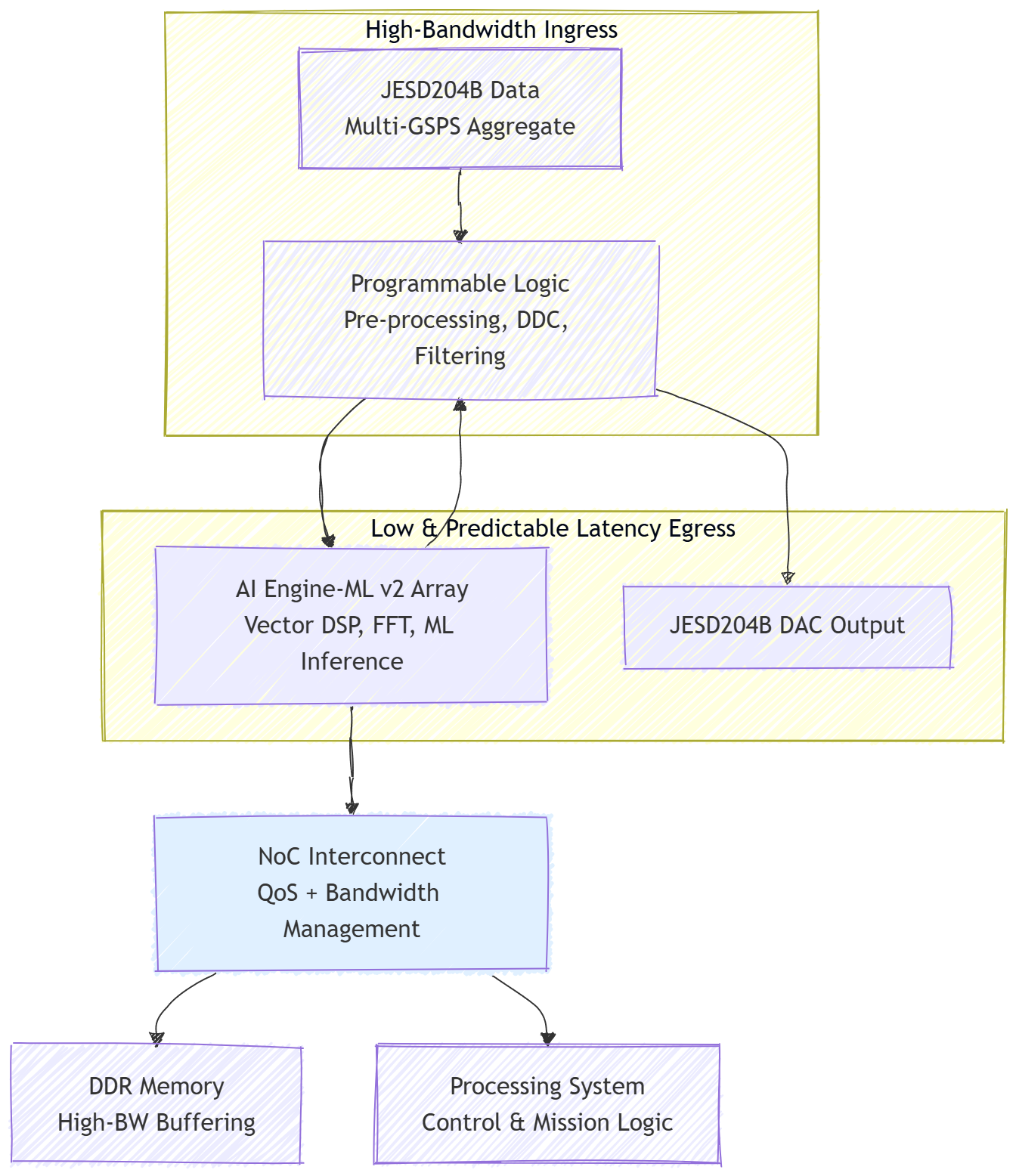
Data entering through the GTYPs is processed by Versal Gen 2’s heterogeneous resources:
- Programmable Logic (PL): Implements JESD204B RX/TX IP cores, digital down-conversion, filtering, and formatting with massive parallel resources.
- AI Engine-ML v2 Array (on AI Edge variants): Highly efficient vector engines optimized for FIR/IIR filters, FFTs, DPD, beamforming, and ML-based signal classification. Streaming interconnects between tiles provide highly deterministic dataflow execution and repeatable latency characteristics for statically scheduled applications.
- Network-on-Chip (NoC): QoS-aware routing with mechanisms for bandwidth reservation and predictable latency under properly engineered traffic conditions.
- DDR Memory Controllers: High-bandwidth buffering for large datasets, although access latency remains less deterministic than on-chip memories such as BRAM and UltraRAM.
- Processing System (APU/RPU): Arm cores handle control, system management, and higher-level mission logic.
End-to-End Versal Gen 2 SDR Processing Pipeline
The combination of Subclass 1 JESD204B synchronization, deterministic dataflow in the AI Engine array, and the NoC’s QoS-managed data paths can enable end-to-end processing latencies in the microsecond range for carefully optimized streaming pipelines. Direct high-speed connections and ample on-chip memory (UltraRAM, Block RAM) help mitigate data starvation issues discussed in Part 3 of the series.
Practical Benefits for Defense and Aerospace Programs
- High-Bandwidth Capture + Real-Time Processing: Ingest up to approximately 500 MHz of instantaneous bandwidth per channel in first-Nyquist operation and perform real-time DSP, spectral analysis, or AI-driven classification.
- Timing Predictability: Essential for coherent multi-channel systems, pulse-Doppler processing, and rapid EW response loops.
- Modular & SOSA-Aligned: Easy integration into OpenVPX chassis; FMC+ modularity allows future upgrades.
- Security & Ruggedness: Secure boot, TPM support, and rugged cooling options provide building blocks for secure and deployable defense systems.
- Accelerated Development: SundanceDSP provides BSPs, Linux drivers, reference designs, and integration support to shorten time-to-mission.
This platform directly supports the “model to mission” transition outlined in Part 4, allowing teams to move advanced algorithms from simulation to deployable hardware with confidence.
Conclusion
For organizations designing next-generation SDR systems, the SE2000 + FMC-ADC500CD combination offers a high-performance, deployment-ready foundation. It uses JESD204B Subclass 1 deterministic synchronization and high-speed serial data interfaces with Versal Gen 2’s powerful NoC, AI Engine-ML v2, and adaptable fabric to capture and process high-bandwidth, multi-channel RF data streams with low, bounded, and predictable latency in demanding defense and aerospace environments.
If your team is evaluating solutions for wideband SIGINT, EW, or multi-function radar, this pairing provides an excellent balance of performance, determinism, and deployment readiness. Contact Sundance DSP for detailed datasheets, availability, reference designs, or to discuss your specific requirements.