
Verifying and Deploying Next-Gen Waveforms
The final stage of any advanced SDR or DSP system is bridging the gap from algorithmic models to reliable mission deployment, especially in aerospace and defense environments. The AMD Versal Gen 2 AI Edge SoC on the SundanceDSP SE2000 3U VPX module with FMC-ADC500CD transforms this process through superior runtime orchestration, enhanced simulation and emulation capabilities, and modular graph control. These features reduce the traditional friction between development and field deployment compared to both traditional FPGA flows and Versal Gen 1 systems.
In classic FPGA DSP pipelines, verification relies on RTL simulation, hardware-in-the-loop (HIL) testing, and extensive timing analysis. Any change to a filter coefficient, FFT size, or beamforming weight often requires full recompilation and re-implementation, with long place-and-route cycles. Runtime adaptability is limited to parameter registers or partial reconfiguration regions that are complex to manage at scale. On the FPGA platform, this meant lengthy integration cycles when adapting to new waveforms or responding to evolving threats in SIGINT/EW applications.
Versal Gen 1 improved the situation by introducing Adaptive Data Flow (ADF) graphs and the XRT runtime. Developers could compile C++ kernels into a graph, simulate behavior with the AI Engine simulator, and deploy via GMIO/PLIO interfaces. However, graph updates often required stopping the entire array, and runtime partitioning options were limited. Debugging stream stalls, bank conflicts, or NoC contention demanded multiple hardware iterations.
Versal Gen 2 makes deployment dramatically easier through refined runtime capabilities, better tooling in the Vitis Unified IDE, and architectural improvements that support independent graph deployment and dynamic control.
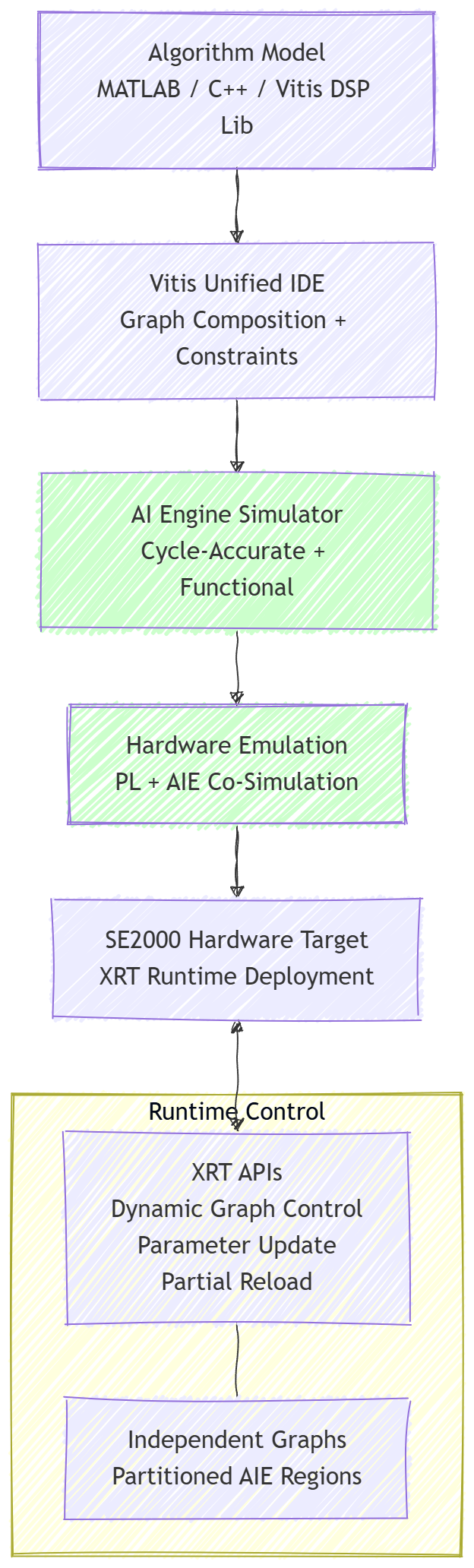
Figure 1: Model-to-mission verification and deployment flow for Gen 2 on the Sundance SE2000. Modular graphs and XRT enable rapid iteration with reduced risk.
The AI Engine simulator in Gen 2 offers improved accuracy for multi-rate DSP pipelines, including detailed modeling of NoC packet routing, memory tile access patterns, and cascade stream behavior. Engineers can analyze stream stalls, bank conflicts in the distributed memory matrix, and deterministic latency across AIE-ML v2 tiles before committing to hardware. This is particularly valuable for FMC-ADC500CD streams, where maintaining sample alignment and phase coherence is non-negotiable for digital beamforming or OFDM demodulation.
Hardware emulation environments combine PL fabric simulation with AIE array models, allowing full end-to-end testing of JESD204B ingestion from the ADC daughter card through NoC into vector kernels and back out via the VPX backplane. AMD’s co-simulation capabilities integrate PS (Cortex-A78AE + R52) software with AIE graphs, validating control-plane orchestration alongside high-throughput data planes.
Runtime partitioning and dynamic control represent a major Gen 2 advantage. Developers can partition the AIE array into independent regions, deploying or updating individual graphs without disrupting others. Using XRT runtime APIs, an application can load new waveform graphs, update FIR coefficients, modify FFT sizes, or reconfigure beamforming weights on-the-fly. This modularity accelerates mission adaptation, critical for electronic warfare systems that must respond to emerging signals or radar modes. Compared to Gen 1, Gen 2 offers finer-grained control, reduced reload overhead, and better support for mixed static/dynamic graphs.
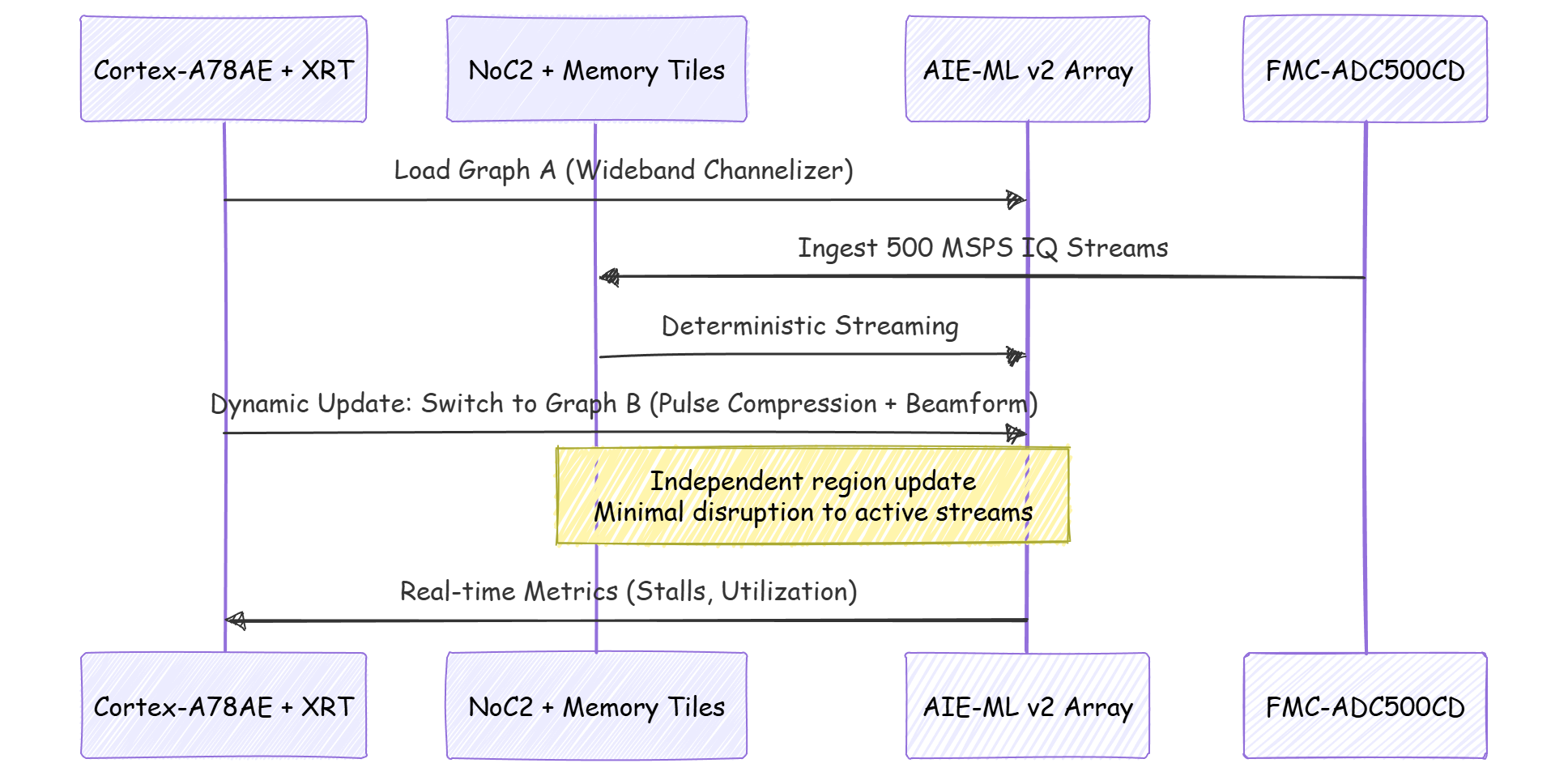 Figure 2: Dynamic graph orchestration sequence on Versal Gen 2. XRT enables runtime waveform switching while preserving ongoing deterministic flows from the high-speed ADCs.
On the SundanceDSP SE2000, these capabilities translate directly to rugged deployments. The 3U VPX module’s thermal and mechanical design supports sustained high-utilization operation in harsh environments. Engineers validate complete receive chains, ADC ingestion through PL, NoC routing, AIE-ML v2 DSP (FIR, polyphase DDC, FFT, adaptive filtering), and output streaming, using the platform’s LPDDR5X for deep buffering and the real-time Cortex-R52 for low-latency control loops. Mission-critical reliability is enhanced by built-in health monitoring, deterministic latency guarantees, and the ability to maintain phase-continuous processing during graph updates.
Vitis Unified IDE workflows streamline the entire pipeline: from graph compilation with placement constraints (optimizing for cascade streams and memory tile proximity), through timing and resource analysis, to automated deployment scripts. Bank conflict analysis reports and stream stall visualizations help architects eliminate bottlenecks that would otherwise surface only on hardware. Partial runtime reconfiguration concepts, while still fabric-oriented in PL, extend effectively to AIE graphs, reducing downtime compared to full array reloads in Gen 1.
Practical examples drawn from AMD repositories include:
- Runtime graph control tutorials demonstrating parameter updates in FIR and FFT kernels.
- XRT examples for multi-graph management and performance counters.
- Adaptive Data Flow graphs with dynamic switching between different beamforming configurations.
- Hardware emulation flows validating packetized multi-channel DDC pipelines.
These tools and architectural features significantly lower integration risk on the SE2000. A development team can simulate wideband SIGINT pipelines, emulate full RF sample rates from the FMC-ADC500CD, validate on a lab Versal board, and deploy to flight-qualified VPX modules with high confidence. The result is a faster transition from prototype to mission-ready waveforms, weeks rather than months in many defense programs.
The combination of powerful AIE-ML v2 vector engines (Part 2), robust NoC and distributed memory (Part 3), and mature runtime/deployment tooling creates a fundamentally more capable platform than traditional FPGA DSP systems or first-generation Versal designs. For SDR architects, this means focusing engineering effort on waveform innovation and system optimization rather than fighting implementation friction.
Versal Gen 2 AI Engines have evolved from promising accelerators into production-grade vector DSP engines that are reshaping edge SDR and radar processing in demanding aerospace and defense applications.